Christo (1935–2020)/Jeanne-Claude (1935–2009), Wall of Oil Barrels—The Iron Curtain, approx. 4 x 4 x 0.5 meters, Rue Visconti, Paris, 1961–62.
Christo & Jeanne-Claude created this temporary work of art against the backdrop of the recently built Berlin Wall. There were also protest demonstrations and barricades about the Algerian War at the time. The work is the first large-format 3D street art sculpture.
Photo: Jean-Dominique Lajoux. Courtesy Christo and Jeanne-Claude Foundation.
- @christojeanneclaude
- #ChristoJeanneClaude
- #RueVisconti
Jérôme Mesnager (*1961), 3 Homme Blancs [3 People in White], brush graffiti, Rue Visconti, Paris, 1986.
Inspired by Zlotykamien's huge figures and punk graffiti, Mesnager was one of the first in Paris to paint illegally and life-size from 1983 onwards. His white, mannequin-like figures can still be seen everywhere in the Paris cityscape today.
Photo: Claire Videau.
- #hommeblanc
- #jeromemesnager
- #ruevisconti
Blek le Rat/Xavier Prou (*1951), Stencil Graffiti, Bando/Philip Lehman (*1965), Spray Graffiti tag, Rue Visconti, Paris, 1984.
Bando is the first style writer in France to influence a generation of writers across Europe. Blek founded the Paris stencil graffiti movement, also known as the Pochoirists. In France, Blek was one of the first to introduce life-size figures into urban spaces.
Photo: Patrick Barry, VG Bild-Kunst, Bonn 2024.
- @original_bando
- #bleklerat
- #ruevisconti
Daniel Buren (*1938), photo souvenir: wild postering, work on site, Rue Visconti, Paris, April 1968.
The conceptual artist Daniel Buren was the first to create illegal artistic wheatpaste works, later called paste-ups. He always used vertical, colored, and white stripes.Photo: Bernard Boyer, Paris. © Daniel Buren / Adagp, Paris. Detail.
- #affichesauvage
- #DanielBuren
- #pasteups
Blek le Rat/Xavier Prou (*1951), Christ, stencil graffiti, Gérard Zlotykamien (*1940), ephemera, spray graffiti, Paella [Chimicos]/Michel Palacios (*1962), poster, Rue Visconti, Paris, 1988.
Three pioneers on one wall: Zloty, the “first” sprayer, the stencil pioneer Blek le Rat, and Paella. Inspired by May 1968, he illegally pasted around 15,000 posters in Paris between 1985 and 1990.
Photo: Xavier Prou/VG Bild-Kunst, 2024.
- @chimicos
- @Zlotykamien
- #bleklerat
Ernest Pignon-Ernest (*1942), Les Gisants de la Commune de Paris [The Reclining Men of the Paris Commune], 2000 screen-printed strips, Butte aux Cailles, Paris 1971.
Pignon-Ernest pasted prints a dead communard on sites associated with freedom struggles, such as Paris Commune locations, the Seine quays or the Charonne metro station. These were places of resistance ante 1945 or sites where police massacred Algerian War opponents in the 1960s.
Photo: Ernest Pignon-Ernest.
- @ernestpignon
- #ernestpignonernest
- #pasteups
Felipe Ehrenberg (1943–2017), Garbage Walk, Spray markings, London 1971.
After the Mexican riots of 1968, the conceptual artist Ehrenberg had to leave his homeland because he his life was in danger. In exile in London, he spray-painted around rubbish on the streets during a prolonged garbage strike.
Photo: Felipe Ehrenberg, VG Bild-Kunst Bonn, 2024.
- #FelipeEhrenberg
- #mailart
- #streetartmexico
Jerzy Treliński, stencil, from the series: Autotautology – o sobie samym – nic [Autotautology ─ about myself - nothing], Zielona Góra, 1976.
From 1972 onwards, the Polish conceptual artist placed his name as a graphic symbol multiple times in various actions in public spaces, for instance on postcards, clothing, etc. Passers-by in socialist Poland at the time were uncertain whether they were dealing with advertising or a government notice.
Photos: Jerzy Trelinski.
- #JerzyTreliński
- #stencilgraffiti
- #streetartpoland
[Follower of] Ted Joans/Theodore Jones (1928-2003), Bird Lives, graffiti, scratched into wet concrete, 13th Street, between 6th and 7th Streets, New York, after 1955.
Shortly after the early death of the jazz musician Charlie Parker (1920-55), who was already legendary during his lifetime, called "Bird", numerous "Bird Lives!" graffiti appeared in New York, mostly written with chalk or charcoal. But here someone scratched it into concrete.
Photo: Michael Dadd.
- #birdlives
- #CharlieParker
- #TedJoans
The affichist Jacques de la Villeglé (1926–2022) at work in Montparnasse, Paris, February 14, 1961.
Villeglé brought torn-off posters into his studio to create decollages. Instead of assembling a picture from set pieces (collage), in a decollage parts of original pictures are removed.
Chalk graffiti drawn by children are visible in the background.
Photo: Shunk-Kender © J. Paul Getty Trust. The Getty Research Institute, L. A. (2014.R.20) Gift of the Roy Lichtenstein Foundation in memory of Harry Shunk & Janos Kender
- #affichistes
- #decollages
- #jacquesvilleglé
Ira Sullivan & Chicago Jazz Quintet, Bird Lives!, vinyl album, 1963.
A few years after Parker's death, Joans' graffiti "Bird Lives" was used on records and books. The slogan was also repeatedly featured in paintings and documentary films about Charlie Parker.
Photo: Stan Malinowski.
- #birdlives
- #CharlieParker
- #TedJoans
Jacques Prévert, Henri Crolla, Chanson Dans Le Sang, vinyl album, Disques Cepedic - CEP 356, France 1960.
The inclusion of street art/graffiti photos on record covers began with this LP. Prévert's language and Brassaï's graffiti have in common the reduced to the essential, the sometimes blunt language of the street.
Cover photo: Brassaï.
- #Brassai͏
- #henricrolla
- #jacquesprevert
Robert Reisner (1921 – 1974): Graffiti. 2000 Years of Wall Writing, New York, 1971.
The art historian and jazz writer Robert Reisner was one of the earliest graffiti researchers in the United States. He also popularized 'Bird Lives' graffiti via his publications.
Lender: Double-H Archives.
- #birdlives
- #bobreisner
- #CharlieParker
Brassai/Gyula Halász (1899–1984), graffiti. Texts, photos and 2 conversations with Picasso, Paris 1961.
The photographer Brassaï declared anonymous Paris scratch graffiti to be art from 1933 onwards. However, it wasn't until 1953 that he was able to gradually publish his photos in mainstream media and to exhibit them from 1956 onwards.
- #Brassai͏
- #Brassai͏̈
- #brassaiigraffiti
Yvan Tessier: Paris Art Libre Dans la Ville, Paris 1991.
In keeping with Prévert's own appreciation of graffiti, the poet himself posthumously became a stencil graffiti made by the 1980s pochoirist group Nice Art around Ariane Pasco (*1958). This work was based on a well-known portrait shot by Prévert's friend, the photographer Robert Doisneau (1912-94). It shows Prévert sitting in a bistro on the Quay Saint-Bernard, Paris, around 1955.
- @pascoariiane__artt
- #jacquesprevert
- #robertdesnos
Raymond Hains (1926 – 2005), Palissade de 8 planches, wooden construction fence, sprayed, 177 × 130 cm, 1970.
Early use of spray paint in an art object carried from the street into the gallery. Hains belonged to the artist group Affichists, who are now considered street art forerunners because they saw the artistic in torn-off posters and spray-painted construction fences from the street and then exhibited them in art spaces.
Lender: Private collection.
- #affichistes
- #decollages
- #RaymondHains
Matsumoto Eiichi (1915–2004), Shadow of a soldier in Nagasaki after the atomic bomb, September 1945, scan of gelatin silver print, 315×207mm.
From 1966 onwards, photos of shadows of atomic bomb victims burned into walls were the template for post-war street art by Ernest Pignon-Ernest, the Aachen muralists, Gerard Zlotykamien and Richard Hambleton.
- @Zlotykamien
- #ernestpignonernest
- #hiroshimashadows
Gérard Zlotykamien (*1940), Personnages disparus, spray graffiti, Argenteuil b. Paris, 1968.
This photo captures the earliest spray graffiti attributed to a street artist. His rounded creatures with empty eyes and hollow mouths, the head separated from the torso, usually in black or white, intended as “an appeal to the fields of death in this world”.
Photo: Archive Eliane & Gérard Zlotykamien, courtesy Galerie Mathgoth, Paris.
- @Zlotykamien
- #ephemeres
- #zlotykamien
Daniel Buren (*1938), photo souvenir: wild postering, work on site on the columns of the École Nationale de Beaux Arts, Paris, April 1968.
Buren's wildly flyposted conceptual art strip posters in public spaces appeared just days before the protest posters of the May riots,some even appearing on on the same walls, including those here at the art academy.
Photo: Bernard Boyer, Paris. © Daniel Buren / Adagp, Paris. Detail.
- #burenstripes
- #DanielBuren
- #pasteups
Atelier Populaire de Beaux Arts [collective], May 1968 Posters, on the columns of the École Nationale de Beaux Arts in Paris, May 1968.
In addition to the posters that would characterize later street art and protest graphics, spray-painted slogans between politics and poetry received great attention here for the first time. The posters from 1968 used puns and pointed contrasts.
Photo: Evènements de May-Juin 1968. Occupation de l''école des Beaux-Arts. Paris, May 1968. © Georges Azenstarck / Roger-Viollet.
- #may1968
- #may1968
- #paris1968
Ernest Pignon-Ernest (*1942), Rimbaud, 2000 screen prints on paper, approx. 195 x 60.5 cm, Paris 1978.
Street art works repeatedly referred to the French poet Arthur Rimbaud (1854 - 91). They were not primarily about his poetry, but about his supposedly wild, anti-bourgeois biography. There are no illegal life-size figures in urban space before Pignon-Ernest. The artist had a huge influence, especially on French street art from Blek le Rat to JR.
Photos: Ernest Pignon-Ernest.
- @ernestpignon
- #ernestpignonernest
- #pasteups
Anonymous [Christian Sébastiani?], Vivre sans temps mort, jouir sans entraves [Life without dead time, Enjoyment without obstacles], spray graffiti, Paris, May 1968.
This last sentence of a text by the artist group Situationists, which was published tens of thousands of times for the student protests, was found spray-painted on walls - at the time a brand new medium in protest and art.
Photo: Jo Schnapp, photographie extraite de L'Imagination au pouvoir [1968] © Éditions Allia, Paris, 2018.
- #jouirsansentraves
- #may1968
- #situationisme
Locations of the sprayer figures, found and entered by AS [Andreas Schmid]. Zurich city map 1978–79. From: Zurich Sprayer: My revolting, my spraying, Bern, 1979.
Naegeli's book is the first self-written "biography" of an illegally operating street artist.
- @harald_naegeli_augenblicke
- @haraldnaegeli_sprayervonzurich
- #haraldnaegeli
Gordon Matta-Clark (1943–1978), Day's End, segment cut in warehouse wall, harbor, Pier 52, Hudson River, New York, 1975.
After Christo's Iron Curtain, Matta-Clark's cut is the second influential illegal sculptural work to have monumental proportions.
Photo: Gordon Matta-Clark, color photography, 109.2 x 109.2 cm. Estate of Gordon Matta Clark. VG Bild-Kunst Bonn, 2024.
- #GordonMattaClark
- #mattaclark
Aachen mural painter [Klaus Paier (1945–2009), Josef Stöhr (*1958)], wall paintings, wall on Augustinerbach opposite Kaiser-Karls-Gymnasium, Aachen 1978–83.
The Aachen muralists illegally painted five times on the same wall. The paintings were aimed at the pupils and teachers there. whenever a mural was removed, the next painting was created. Today the last work created is a listed work and is the only illegal work from this exhibition still preserved on site.
- #aachenerwandmaler
- #klauspaier
- #streetartaachen
Zurich sprayer/Harald Naegeli (*1939), spray drawings, Zurich, 1978–79.
Circa 1980 no other European street artist had more media coverage than Naegeli. His virtuosic spray figures were based on his political agenda. These police photos were used in a trial against him. Naegeli fled to Cologne/Düsseldorf. He continued to spray until sent to prison for 6 months in 1984, despite support from Willy Brandt and Joseph Beuys. Photos: Zurich City Police, 1978–79. Kunsthaus Zurich Collection.
- @harald_naegeli_augenblicke
- @haraldnaegeli_sprayervonzurich
- #haraldnaegeli
Richard Hambleton (1952–2017), I only have Eyes for you, paste-up, 228.6 x 91.4 cm, ca. 1980; Konk, Mudmen, postpunk band stencil and lettering, ca. 1982, Avant [collective, here: David Fried], poster, acrylic on newspaper, New York, ca. 11982–83.
Hambleton anonymously posted hundreds of photos of himself in New York. He chose paper that quickly faded, so that soon only white shadows remained, inviting comments.
- #avantstreetart
- #konkband
- #RichardHambleton
Artur [Hans-Georg] Dieckhoff (1948–2020), you ask me, what should I do? And I say: Live wild and dangerous, Artur, ca. 1981.
First artistic illegal flyposter in Germany, Hamburg. Often incorrectly attributed to Rimbaud, this saying was found on postcards and posters in countless student shared apartments in the 1980s.
Photo: Klaus Raasch.
- #arturdieckhoff
- #klausraasch
- #livewildanddangerousarthur
Jean-Michel Basquiat (1960-1988), Keith Haring(1958-1990), various graffiti writers, marker tags and drawings, David Wojnarowicz (1954-1992), Burning House, stencil graffiti, Alex Vallauri (1949-1987), NY, 1982–83.
Photo: The Door by Fernando Natalici.
- @natalicifernando
- @wojfound
- #AlexVallauri
Alte Schule [old school], compilation album, 12 Inch Vinyl, 1993.
Designed by British graffiti character innovator Mode 2 (Maxime Nicoll, *1967), this record united German rap greats from the 1990s with a focus on Heidelberg. Zebster (Achim Walta, *1970), the Stieber Twins (*1972) and Torch (Frederik Hahn, *1972) were also early graffiti writers themselves. A photo collage in the record's inlay shows the four elements of hip hop: djing, rap, graffiti and breakdancing. Early European hip-hop pioneers were usually active in several of these areas.
- @mode2official
- #mode2
- #stiebertwins
Artifacts, Wrong Side Of Da Tracks, 12 inch vinyl single, 1994.
The Artifacts duo included rapper/graffiti writer Tame One (Rahem Ross Brown, 1970–2022). The Artifacts Graffiti Outline was designed by known graffiti writer Reas (Todd James, *1969). The cover photo was taken by the famous photographer and hip-hop documenter Martha Cooper (*1940). The song lyrics often touch on the topic of graffiti.
Jacob Kimvall Collection.
- @MarthaCoopergram
- @toddjamesreas
- #tameone
Jellybean, Wotupski!?!, 12 inch vinyl LP, 1984.
The cover graffiti, designed by the New York writers Seen (Richard Mirando, *1961) and Duster (*1964), was often copied - for example by the Stockholm Graffiti Writer Speedy as early as 1985.[Jacob Kimvall] The most successful song on the record, Sidewalk Talk, was written by occasional tagger Madonna. John Jellybean Benitez was her lover at the time. She previously dated SAMO© member Basquiat.
Jacob Kimvall Collection.
- @classicseen
- @dusternyc
David Wojnarowicz (1954-1992), Untitled ("Friendly Cow" for Peter Hujar), spray drawing, 2nd Avenue & 12th Street, Lower East Side, New York, 1982.
The stencil graffiti pioneer soon became a well-known painter of the East Village art scene. This drawing was created to be visible from the apartment of his mentor, the photographer Hujar. Both died of AIDS in this apartment.
Photo: David Wojnarowicz, 8.9 x 14 cm. Estate of David Wojnarowicz and PPOW, New York.
- @peterhujararchive
- @wojfound
- #davidwojnarowicz
Jane Bauman (*ca. 1960), Flipper [homage to the San Francisco punk band of the same name], spray stencil graffiti, corner of 9th Street & 1st Avenue, New York, early 1980s.
The upside down and “flipped” map of America is reminiscent of the 1950s TV dolphin of the same name. Coming from the San Francisco punk scene, Bauman also collaborated in New York with stencil graffiti artists such as David Wojnarowicz.
- @janemagdalenabauman
- #flipperband
- #stencilgraffiti
Jane Bauman (*ca. 1960), spray stencils on plywood wall, 34 x 104 x 3 cm, dismantled Rivington St., New York, 1983.
In 2020, the New York stencil graffiti pioneer Bauman exhibited a series of original stencils created from 1980 onwards. There was a photo of stencil graffiti on Rivington Street in the catalog. After the exhibition, a collector contacted Bauman and returned to her the plywood wall that had been stolen from the street, along with some of her graffiti. This is part of her “Men in Distress” series.
Gift from the artist.
- @janemagdalenabauman
- #janebauman
- #stencilgraffiti
Gary Hütter/John Fekner (*1950), Random Dates, 2 original cardboard stencils 1976-77, Queens, New York. Each approx. 30 x 23 cm.
Fekner's first illegal, still apolitical stencil series consisted of past, [then] present and future years. Designed to be viewed from the car, it should bring back individual memories.
Lender: Ulrich Blanché
- @JohnFekner
- #JohnFekner
- #stencilgraffiti
Aroldo Marinai, Frogman & [later] Massimo Guasti, Mermaid, stencil graffiti, Florence, 1979/80.
Marinai visited his brother in NYC in 1979 and saw Eric Drooker's anonymous Umbrella Man stencil graffiti. This inspired him to start the early European stencil graffiti campaign “Frogmen” in Florence that same year. The artist's book is one of the first of its kind.
- @eric.drooker
- #aroldomarinai.#firenzestreetart
Stations of the Elevated (46 min., directed by Manny Kirchheimer), 1981.
Kirchheimer (*1931) from Saarbrücken, who fled from the Nazis, filmed the material for this first New York graffiti documentary in 1977. Accompanied by a jazz soundtrack, the camera follows subways painted with graffiti, for example by Lee (Quiñones, *1960) or Daze (Chris Ellis, *1962). Kirchheimer contrasts the illegal graffiti with huge, sometimes more provocative legal billboards.
- @leequinones
- #mannykirchheimer
- #stationsoftheelevated
E LiL ART DE HOYO MARA [the small Art[ur] from [the neighborhood] Hoyo Mara], Cholo Graffiti, East Los Angeles, 1963.
Derived from Aztec xolotl [dog], “cholo” was used in the United States as a derogatory term for a person of Mexican origin. In the 1960s, Mexican-American activists reclaimed the term “cholo.”
Photo: Ben Lomas. Lomas and Weltman Collection, 1965. ©Susan Phillips.
- @professorshoeshine
- #cholograffiti
LOS LiL ARAÑAS TRece MOTA [The small Spiders 13 Mota], Cholo Graffiti, East Los Angeles, 1963-65.
MOTA = Medicine Of The Angels [ Marijuana ]. " I don't think they were referencing the Mexican Mafia. In L.A. when we write the number 13 [in ABC = M] we are always talking about Marijuana. I think it a fun tag bragging about getting high, with a 'Beautiful Script'.”[Chaz Bojorquez].
Photo: Ben Lomas. Lomas and Weltman Collection, 1965. ©Susan Phillips.
- @professorshoeshine
- #cholograffiti
Dr. Charles Chaz Bojórquez (*1949), Señor Suerte [Mr. Lucky], stencil graffiti, and Veteranos Roll Call, Cholograffiti, Los Angeles, 1975.
Bojórquez Señor Suerte Stencil (1969) is one of the first stencil graffiti artists and was active in illegal Mexican-American street calligraphy (cholo graffiti) until 1986. Here he sprayed roll calls [list of friends, in gangs: members] in the gang graffiti tradition.
Photo: Blades/Kathryn Bojorquez.
- @chaz_bojorquez
- #chazbojorquez
Blades/Kathryn Jones/Bojórquez, Blades, Spray Day, Highland Park, Los Angeles 1973-74.
Blades is so named because she stabbed her first friend. A year after she spray-painted her only tag ever, in the Cholo graffiti tradition, gang members derogatorily added Puta (whore) and La Loca (the crazy one).
Photo: Gusmano Cesaretti.
- @gusmanoc
- #chazbojorquez
TRU, scratch graffiti, S-Bahn window pane, 91.5 x 41.5 cm, Berlin, ca. 1995.
The first book about scratch graffiti on window panes was published anonymously as early as 1731, scratched by anonymous noble vandals with diamond rings who were no longer illiterate. This most enduring form of graffiti gave the term its name.
Dirk Sold Collection.
- #berlingraffiti
- #sbahngraffiti
- #scratchgraffiti
A New Kilroy: Taki 183. International Herald Tribune. English edition for France, July 24/25, 1971, p. 14. Text without second photo identical to [Mark Perlgut]: "'Taki 183'" spawns Pen Pals In: The New York Times, July 21, 1971, p. 37.
The article sparked a graffiti boom in New York. A little later, the mayor had to pass a law against graffiti. The article also appeared in Europe with a different title. This was perhaps the first time to read about style writing graffiti in Europe.
- @taki183
- #Joe182
- #taki183
Taki 183/ Demetrius (ca. *1953), Joe 182, Junior 161, etc. Marker tags, 183rd Street, New York, 1971.
Photographed by Don Hogan Charles, the New York Times' first black photographer, who went to 183rd Street, where tagger Taki 183 lived. As a bike messenger, Taki was one of the first to make his illegal mark all over New York - not just in his neighborhood.
Photo: Don Hogan Charles/The New York Times.
- @taki183
- #donhogancharles
- #taki183
(Lady) Pink/Sandra Fabara (*1964), Mick(ey) La Rock/Aileen Middel (*1970), Pink, Mick, graffiti pieces on freight train wagon, USA, 1995.
A rigid anti-graffiti policy in the city of New York focused on clean subways and in the 1980s pushed graffiti from the New York subways onto freight trains, on which they traveled across the country, sometimes for decades.
Photo: Sandra Fabara/Aileen Middel.
- @ladypinknyc
- @micklarock01
- #freighttrainingraffiti
Rammellzee vs. K-Rob, Beat Bop, 12 inch vinyl single, 1983.
Rammelzee rapped in his oft-copied nasal sneer gangster duck in the graffiti movie Wild Style (1982). Beat Bop, produced and designed by street art pioneer Jean-Michel Basquiat, is a rap battle between the hip-hop all-rounder Rammelzee and the then only 15-year-old K-Rob. The influential Beat Bop was on the soundtrack of the graffiti documentary Style Wars (1983).
Jacob Kimvall Collection.
- @albert_diaz1
- @therammellzee
(Lady) Pink/Sandra Fabara (*1964), Mick(ey) La Rock/Aileen Middel (*1970), Pink, Mick, graffiti pieces on freight train wagon, USA, 1994.
The most prominent female New York writer Pink painted freight trains early on. Here she collaborates with one of the first European female writers Mick. She comes from Groningen and has been active since 1983.
Photo: Sandra Fabara/Aileen Middel.
- @ladypinknyc
- @micklarock01
- #freighttrainingraffiti
Gettovetts – Missionaries Moving, 12 inch vinyl LP, 1988.
The cover is by graffiti writer Rammellzee (1960-2010), a member of the Ghettovetts. The first print run of the cover shows the group name as complex wild-style lettering - difficult to read even for style writing connoisseurs. For subsequent releases, the group name on the covers was simplified, probably contrary to Rammellzee's artistic vision. [Jacob Kimvall]
Jacob Kimvall Collection.
- @therammellzee
- #Gettovetts
- #rammelzee
Barbara 62 (* approx. 1957), Eva 62 (* ca. 1957), Michelle 62, Phase 2/ Michael Marrow (1955-2019), Joe 136, Joe 182, FDT-56, [Thomas] Lee 163rd , etc . Style Writing Tags, 136th St. East Broadway, Queens, New York, ca. 1971-76.
This Hall of Fame of famous writers existed for almost 20 years. Barbara 62 made early steps in the direction of larger, multi-coloured graffiti pieces. Phase 2, also represented here, brought significant stylistic innovations as a train graffiti writer.
Photo: Andrea Nelli.
- @andrea__nelli
- #eva62
Futura 2000, The Escapades Of Futura 2000, Vinyl Maxi Single, 1982.
Futura, one of New York's most influential graffiti writers, raps here to music by the punk band The Clash. Spray-painting life with The Clash on a European tour, he left behind early graffiti in London and Paris in 1981. The 1982 record also features his famous graffiti writer colleagues Dondi and Fab5 Freddie. In the lyrics, Futura talks about his graffiti career and mentions important graffiti and street art colleagues.
- @futuradosmil
Lee/Quiñones (*1960), Lee Mono Doc Merry Christmas train, summer 1977.
This Lee graffiti train was the first of hundreds to be shot by photographer Henry Chalfant. He used it to develop his technique of photo frame-cropping graffitied train cars like canvases. Chalfant composed each photo from several individual shots taken parallel to the train car.
Photo: Henry Chalfant.
- @LeeQuinones
- #HenryChalfant
- #LeeQuinones
Phase II, The Roxy, 12 inch vinyl single, 1982.
The graffiti writer legend and style innovator Phase 2 (Michael Marrow, 1955-2019) was also a rapper, here he is standing in front of his graffiti tag. The Roxy refers to a formerly well-known New York club where hip-hop was performed early on. In addition to breakdance competitions and graffiti walls, there were also concerts by Run DMC, among others . Part of a painting by his fellow writer Futura 2000 is printed on the back.
Jacob Kimvall Collection.
- @futuradosmil
- #theroxynyc
Fab Five Freddy, Une Sale Histoire, Vinyl Maxi Single, 1982.
Hiphop impressario Frederick Brathwaite (*1959) aka Fab Five Freddy linked graffiti writers and street artists from 1980 onwards, first in New York, then internationally.
The back cover is part of a graffiti writer Futura 2000/Leonard McGurr (*1955) artwork, that links up with four other record covers all present in this exhibition.
- @fab5freddy
- @futuradosmil
Old school Classics, 12 inch vinyl album, 1989.
NYC graffiti writer Joey Serve Vega created more than 30 album covers, most notably for the Tuff City record label. At some point, the title Old school Classics in graffiti font was overlaid with the same title in plain white font. This was probably done for better readability and thus for better marketing. Vega published his book The Ultimate Black Book Vol. 1: Serve in 2013.
Jacob Kimvall Collection.
- @servefba
- @tuffcityrecords
Quik/Lin Felton (*1958), Whole Car, 1980. Chalfant.
The real first name (Lin Felton) of the writer, who started as a tagger around 1970 in Queens, New York, also appears in this Quik waggon. From 1980 he also designed canvases and exhibited in galleries.
Photo: Henry Chalfant.
RUN DMC, Mary Mary, 7 inch vinyl single, 1988.
Banksy featured this record in one of his exhibitions as early inspiration. The rap-rock single included a band logo stencil that could be used for graffiti. The Run DMC logo became a commonly used formula for street stickers. RUN DMC made their television debut in 1984 on the show Graffiti Rock.
- @RundDMC
- #raprock
- #RundDMC
Lee/Quiñones (*1960), Energy From My Soul, Whole Car, 180th Street, Bronx, 1980.
This was Martha Cooper's first train graffiti photo. Like Henry Chalfant's she took a picture of a Lee train. Photojournalist and ethnographer Cooper photographed graffiti with a lot of context. The first documented Lee train cars date from 1975.
Photo: Martha Cooper.
- @LeeQuinones
- @marthacoopergram
- #LeeQuinones
The Increadible TH [= Die Toten Hosen] Scratchers Starring Freddy Love, Hip-op-Bommi-Bop, 12 inch vinyl single, 1983.
Inspired by The Clash, the Düsseldorf punks Die Toten Hosen collaborated here with the graffiti writer and pioneer of the New York hip-hop scene Fab 5 Freddy (Fred Brathwaite, *1959). The rap song Hip Hop Bommi Bop parodied the Tote Hosen hit Eisgekühlter Bommerlunder and appears to be the first crossover punk rap record internationally.
- @dietotenhosen_official
- @fab5freddy
Futura 2000/Leonard McGurr (*1955) Break, Whole Car, Hoe Avenue, South Bronx, 1980.
This pioneer of abstract graffiti played an important role as a promoter of style writing in Europe. He sprayed and rapped live there during concerts by the punk band The Clash.
Photo: Martha Cooper.
- @marthacoopergram
Die Toten Hosen, Live! Bis zum bitteren Ende [until the bitter end], vinyl album with enclosed band logo cardboard template, November 30, 1987.
As die-hard fans of the English punk band The Clash, Die Toten Hosen followed their example. The Clash had already put a cardboard stencil in a record in 1982 - in the punk stencil tradition of Crass and TRB. The Tote Hosen predecessor band ZK had already sprayed punk graffiti.
- @dietotenhosen_official
- #DieTotenHosen
- #stencilgraffiti
The Clash, Should I Stay Or Should I Go / Straight To Hell, 12 inch UK vinyl single, September 17, 1982.
The Clash sprayed punk graffiti and designed do-it-yourself punk shirts. With the cardboard stencil they refer to the guerrilla group Sandinistas, who overthrew a dictator in Nicaragua in 1979 - also with the help of political stencil graffiti. Banksy inspirer Robert del Naja started stencil graffiti partly because of The Clash: “I remember getting records from […] The Clash, they put stencils in their sleeves that you could use to paint on your clothes and all over the walls.”
- @the_clash
Vandal/Barrett Zinn Gross (*1962), Whole Car, 1980.
"My style [...] was bold block letters and lots of bright colors [...]. This piece was like a rainbow with six Krylon colors that came from one pass to the other." In 2023, Banksy cited this work as inspiration for his early work.
Photo: Martha Cooper.
- @marthacoopergram
- #rtwcrew
Tom Robinson Band [TRB], Power in the Darkness, vinyl album, May 1978.
The British political punks TRB were the first to include a cardboard stencil with the band logo as a gimmick with a record. Small print underneath read: "This stencil is not intended for spraying on public property!!!". In addition to walls, its size and motif were also suitable for clothing and hairstyles. TRB knew the Faust logo from gay rights publications.
- #powerinthedarkness
- #tomrobinsonband
Fab Five Freddy/Frederick Brathwaite (*1959) & Lee/Quiñones (*1960), Campbell's Soup Car, whole car, 1980.
In Campbell's Soup, Brathwaite integrated graffiti into art history - Warhol's Pop Art and the Dada art movement. Fabulous Soup is a tribute to Fred's graffiti crew The Fab 5 and TV Soup to the New York underground TV show TV Party (1978-82).
Photo: Martha Cooper.
- @fab5freddy
- @LeeQuinones
- @marthacoopergram
Bamboula Nouba - Le Disque De La Fête, 12 inch vinyl maxi single, 1986.
The graffiti piece on the cover was designed by the European graffiti writing pioneers Bando (Phillip Lehman, *1965) and Mode 2 (Maxime Nicoll, *1967). Their crew CTK (Crime Time Kings) was the first European graffiti crew. This record includes an 8-page fold-out booklet with party instructions and non-alcoholic cocktail recipes.
Jacob Kimvall Collection.
- @mode2official
- @original_bando
- #BandoCTK
Dondi /Donald White (1961-98), Children of the Grave [Part 3], whole car, 1980.
The influential main work of the “Style Master General”, who died early from AIDS, quotes a song by the English heavy metal and hard rock band Black-Sabbath in the title and the underground cartoonist Vaughn Bode (1941-75) in the characters.
Photo: Martha Cooper.
- @marthacoopergram
- @vaughnbodeofficia
- #dondiwhite
Les Araignées Du Soir, No Wave, 12 inch vinyl EP, 1983.
The graffiti-inspired letters on Les Araignées Du Soir 's only record were designed by Epsylon Point [Étienne Lelong, b.1950], stencil graffiti pioneer and the band's guitarist. At times with his partner La Signe (*1948) he created multi-colored stencils with often explicitly sexual content.
- @epsylon_point
- #epsylon point
Seen/Richard Mirando (*1961) & P-jay & Kel/Randy Rodriguez (*1963) and Blade/Steven Ogburn (*1957), Blade Walking, whole cars, South Bronx, 1980.
Blade's walking stilt letters are among the most reproduced graffiti features.
Photo: Martha Cooper.
- @bladekingofgraf
- @graffitiloser
- @marthacoopergram
(Lady) Pink/Sandra Fabara (*1964) & Iz The Wiz/Michael Martin (1958-2009) & Mare, John Lennon, The Beatles, Double-Whole Car, 1981.
For four years, this illegal two-car tribute to the murdered John Lennon traveled in tandem through New York as the cleaning staff refused to sand blast it.
Photo: Martha Cooper.
- @izthewiztmb
- @ladypinknyc
- @marthacoopergram
Daze /Christopher Ellis (*1962) & Crash/John Matos (*1961), Whole Car, 1980.
From 1977, Daze and Crash illegally painted trains together and continued to share a studio in 2020. They painted on canvases early on and collaborated with artists such as John Fekner and Walter Dahn.
Photo: Martha Cooper, 1981.
- @crashone
- @dazeworldnyc
- @marthacoopergram
Conflict, The House That Man Built. 7 inch vinyl single, Crass Records, 1982.
Like Crass, on whose label this record was released, the punks Conflict also made political punk stencil graffiti. Another one was documented in Jill Posener's 1982 book.
- #anarchopunk
- #crassrecords
- #mortarhaterecords
Phase 2/Michael Marrow (1955-2019), Skeme/John Cecil Dash (*1964), Tuff City, Whole Car. Bronx, 1982.
The graffiti pioneer Phase 2 is considered the inventor and further developer of graffiti writing styles such as the bubble style with rounded, soft bubble-like letters. With the younger writer Skeme he created an early example of guerrilla marketing - Tuff City is a record label.
Photo: Martha Cooper.
- @marthacoopergram
- @tuffcityrecords skemegraffiti
Crass, Stations of the Crass, 31 x 62 cm, vinyl album, Crass Records, August 11, 1979.
The punk and later hip-hop pioneer and Massive Attack musician Robert del Naja was inspired by the stencils on this record to do graffiti himself under the name “3D”. He brought Banksy to spray paint in Bristol, as the latter emphasizes in interviews.
- @crasswords
- #crassband
- #robertdelnaja
Crass / Poison Girls, Bloody Revolutions / Persons Unknown, 7 inch vinyl single, May 1980.
Instead of Blek le Rat, Crass' stencil graffiti and Gee Vaucher's Crass cover images were influential for street artists like Robert del Naja and Banksy.
- @crasswords
- #geevaucher
- #poisongirls
Stay High 149 /Wayne Roberts (1950-2012), Smoker, Spray Graffiti Figure Day, 149th Street, Bronx, New York City, 1985.
Stay High revolutionized the early, often all-letter tags by adding his repeatedly copied character of a smoking stick figure, as well as other figural elements.
Photo: Matt Weber.
- @matt.weber.photos
- @stayhigh149
- #StayHigh149
Bando/Philippe Lehman (*1965), Blitz, CRIMINAL ART, graffiti piece [lettering] incl. Doc, graffiti character [figure], Stalingrad, Paris, 1984.
A wasteland near the Stalingrad subway station became a mecca for European graffiti writers and hip-hop pioneers. CRIMINAL ART was emblazoned frontally opposite the metro entrance. With its programmatic title, the piece is an early highlight of young French style writing, imported from New York in 1983 by the half-French Bando.
Photo: Claude Abron.
- @claudeabronphoto
- @original_bando
- #terrainvaguedelachapelle
Crass [successor], how to make a stencil, in: Ian C. (ed.): No Easy Answers, No. 1, punk Zine, 1980. UB Collection.
In keeping with the do-it-yourself principle of punk, punk zines not only discussed records and concerts, but also, as here, gave detailed instructions and copy templates on how you could spray stencil graffiti like Crass.
- @crasswords
- #punkzines
- #stencilgraffiti
Crass, Man Made Power. Man Made Pain, Stencil Graffiti, West End, London 1980.
Crass spraypainted a lyric from one of their songs here as an anti-nuclear slogan. Punk band manager and author of the first lesbian play in England, the photographer Jill Posener, documented this stencil. Shepublished political and early feminist graffiti in an illustrated book called Spray it loud (1982)
Photo: Jill Posener.
- @crasswords
- @jill_posener_photography
- #JillPosener
Dave King (1943 - 2016), Penny Rimbaud/ J eremy Ratter (*1943), Crass logo, 1977, gimmick stencil, 29.5 x 21 cm, released on April 13, 2019 together with a flexi disk for the song »Do the owe us a living?”
The logo of the anarchist punk band Crass criticizes symbols of power. It was also designed with the premise of being used as a stencil for graffiti.
- @crasswords
- @davidking_estate
- #PennyRimbaud
Deutschland Kaput. Germany is kaputt!, sticker, Masłav, reprint of a sticker from around 1942, Warsaw, around 1995.
The earliest examples of illegal stickers are the postage stamp-sized Polish anti-Nazi stickers placed by “Little Sabotage” resistance fighters. The stickers were called Motyle [butterflies]. The term shows the proximity to the flyer - before it was stuck, the sticker was a small leaflet.
Photo: Vlepkronika Archive.
- #małysabotaż
- #streetsticker
Bando/Philippe Lehman (*1965), Pride/Errol Donald, AEROSOL ART, graffiti piece [lettering] incl. Mode 2/Maxime Nicoll (*1967), graffiti character [figure], Stalingrad, Paris, 1985.
Prominently published in the illustrated book Spray Can Art, which was groundbreaking for many European spray painters, this piece was painted by the leaders of the Paris and London scenes
Photo: Claude Abron.
- @mode2official
- @pridetca
- #terrainvaguedelachapelle
OBEY/Shepard Fairey (*1970), Andre the Giant has a posse, Los Angeles, 1989.
The international sticker campaign was initiated by the skate punk Fairey - inspired by John Carpenter's film “They Live” (1988). There, the main character uses special glasses to expose outdoor advertising as a national brainwashing of aliens who demand obedience (OBEY).
Lender: Archive Double-H.
- @obeygiant
- #andrethegianthasaposse
- #ShepardFairey
Guglielmo Achille Cavellini (1914–1990), CAVELLINI 1914 – 2014, Venezia - Palazzo Ducale, 7 Settembre - 27 Ottobre, sticker, 10.5cm (diameter), approx. 1974–1980.
As part of his “Autostoricizzazione” [self-historicization] project, the mail artist printed thousands of stickers. He promoted an imaginary exhibition in Venice on the occasion of his 100th birthday. The stickers were distributed worldwide from 1974.
Lender: Archive Center for Artist Publications in the Weserburg Museum for Modern Art.
- @guglielmoachillecavellini
- #guglielmoachillecavellini
- #mailart
Sens/Bando/Philippe Lehman (*1965), Shoe/Niels Meulman (*1967), Colt/Deen, SENSHOEDEEN Roc, graffiti piece [lettering], Mode2/Maxime Nicoll (*1967), graffiti character [figure], CTK [Crime Time Kings] Crew, Stalingrad, Paris, 1986.
The piece was sprayed by CTK, the first European crew, an association of writers from Paris, Amsterdam and London. Since several people integrated the same crew abbreviation into graffiti pieces, a higher level of recognition was achieved.
Photo: Gérard Guittot, ©westside kingz [David Eone Hachour].
- @nielsshoemeulman
- @west_side_kingz_le_livre
- #crimetimekings
Klaus Staeck (*1938), Rents Must Rise, Votes Christian Democratic, sticker, 1971.
The poster artist Staeck early on sold stickers that always went beyond pure political activism, as here with timeless, irritating messages.
Ulrich Blanché Collection.
- #KlausStaeck
- #streetstickers
Vampi(rella)/Valesca M, scan from her Blackbook, 1985.
As Perenix [“Pears? No”], this early European writer began punk graffiti in Amsterdam in 1980. “In 1981, I fell into the halfpipe at Waterlooplein while rollerskating and broke all four of my front teeth. I was still in the punk scene and I didn't care about walking around like that for a year. That’s why I got the nickname Vampirella [like the horror comic character created in 1969], but it has nothing to do with my first name.”
- @dutch_graffiti_library
Timm Ulrichs (*1940), No sticking on notes!, sticker, 3.5 x 7 cm, 1964.
The later internationally known conceptual artist illegally attached this very early proto-street art sticker to buildings at his art college and was subsequently suspended, among other things. Self-adhesive stickers have been around since 1935. They have been used indoors and outdoors, for example for advertising.
Lender: Archive Center for Artist Publications in the Weserburg Museum for Modern Art.
- #conceptualart
- #streetstickers
- #TimmUlrichs
Vampi(rella)/Valesca M., Vampi, Spray Graffiti, Amsterdam, May 1, 1985.
Graffiti writer Vampirella (Valesca M.) posed with a skateboard in front of her VAMPI piece in Amsterdam on May 1, 1985. Motorcycle police officers look on. Someone had set the graffiti on fire during the usual Queen's Day riots (like May Day in Germany). Vampirella refers to the fire with her cigarette and her arm gesture to her graffiti figure.
Photo: Valesca M.
- @dutch_graffiti_library
- #vondelparkgraffiti
Soundtrack LP for the film Wild Style, 1982.
The Wild Style mural was designed by Zephyr (Andrew Witten, *1961), Revolt and Sharp in 1983 and is now one of the most famous graffiti ever.
- @drrevoltrtw
- @wildstylethemovie
- @zephyrgraffiti
Vampi(rella)/Valesca M, scan from her Blackbook, 1985.
Even as the graffiti style developed from punk to hip-hop, Vampi's tag remained a simple handwriting.
- @dutch_graffiti_library
- @graffitiamsterdam
- #vondelparkgraffiti
Vampirella/Valesca M, face, spray graffiti, Oude Mannen Huisje, Vondelpark, Amsterdam, May 1, 1985.
Vampi is captured here removing sexist insults from one of her works at a club in Vondelpark, a typical Amsterdam graffiti location at that time.
International Graffiti Times, early graffiti zine, 1984.
After graffiti films and illustrated books before 1985, inspiration and exchange also in Europe came more and more through photos in self-published graffiti zines after the Interrail graffiti trips of important writers.
Lender: Double-H Archive.
- #graffitizines
- #igtimes
- #internationalgraffititimes
Charlie Ahearn: Wild Style, semi-documentary graffiti film, New York, 1983. VHS.
The main character Raymond or Zoro is a celebrated but anonymous graffiti writer. The film describes his life and documents the then new interest in hip-hop culture among the media and the established art scene. Along with the illustrated book Subway Art, this film was probably the main inspiration for many writers around the world. On VHS, graffiti in the film was paused and copied.
Lender: Double-H Archive.
- @twincharlie
- @wildstylethemovie
- #wildstyle
Alex Vallauri (1949-1987), David Wojnarowicz (1954-1992), Quik/Lin Felton (*1958) etc.,
Photos from Vallauri's estate make it clear that Vallauri's stencils were added to this wall at different times. Wojnarowicz soldier was there first. Both artists died of AIDS.
Lender: Ulrich Blanché
- @quikrtw
- #alexvallauri
- #davidwojnarowicz
Graffiti Report, Tele Journal (director: Roland Helm, 1.25 min.), SR, February 13, 1987.
The article summarizes the West German graffiti development in Saarbrücken - from political slogans in the 1968 tradition (riot resistance, no nuclear power plants) to 1980 fun slogan graffiti (Sex, Dope & Anarchy is all we need in Germany) to the first style writing graffiti, where, among other things, graffiti films (Wild Style [1982], Beat Street [1985]) and records ( Scratch & Break [1983]) are cited.
- @wildstylethemovie
- #beatstreet
Reso (*1975), DLK [DibbeLabbes Klan], 2 Scien & Miss Clore. Saarbrücken, 1995.
The international Saarbrücken native saw graffiti in Paris and New York early on. An early inspiration was the New York graffiti writer Dero. Reso soon also collaborated with the duo 123KLAN from northern France.
Photo ©Reso.
- @123klan
- @resostudio
- #saarlandgraffiti
Can Two/Fedor Wildhardt (*1970), pseudo, train graffiti, Wiesbaden, 1988.
Cool Candy, who started spraying in 1983, is one of the earliest German graffiti writers and, from 1986, became as CanTwo one of the most influential ones. Breakdancer Niels “Storm” Robitzky poses on top of a CanTwo piece.
Photo: Can Two.
- @cantwo
- @storm_seriou
- #CanTwo
(Claudia) Diak, (David Herion) Soner (*1974), DIAK SONER, graffiti, Metz railway line, 1995.
Diak in Metz and Rosy One in Switzerland were among the few female graffiti writers of that time.
Photo ©Diac.
- @davidsoner1
- #davidsoner1
- #metzgraffiti
Ultra Color
This rare Vogelsang spray can was the standard graffiti spray can available in every hardware store in Germany in the 1980s. From around 1989 it was renamed Dupli Color.
- #duplicolor
- #spraypaintcollector
- #ultracolorspray
David Wojnarowicz (1954-1992) Burning House, plastic stencil, 1981, PPOW Gallery, estate edition 2019, 29.7 x 20.9 cm.
This stencil was omnipresent in Manhattan in 1981. The ambivalent motif became a kind of Wojnarowicz logo and paved his way into the art world.
Lender: Ulrich Blanché
- @wojfound
- #davidwojnarowicz
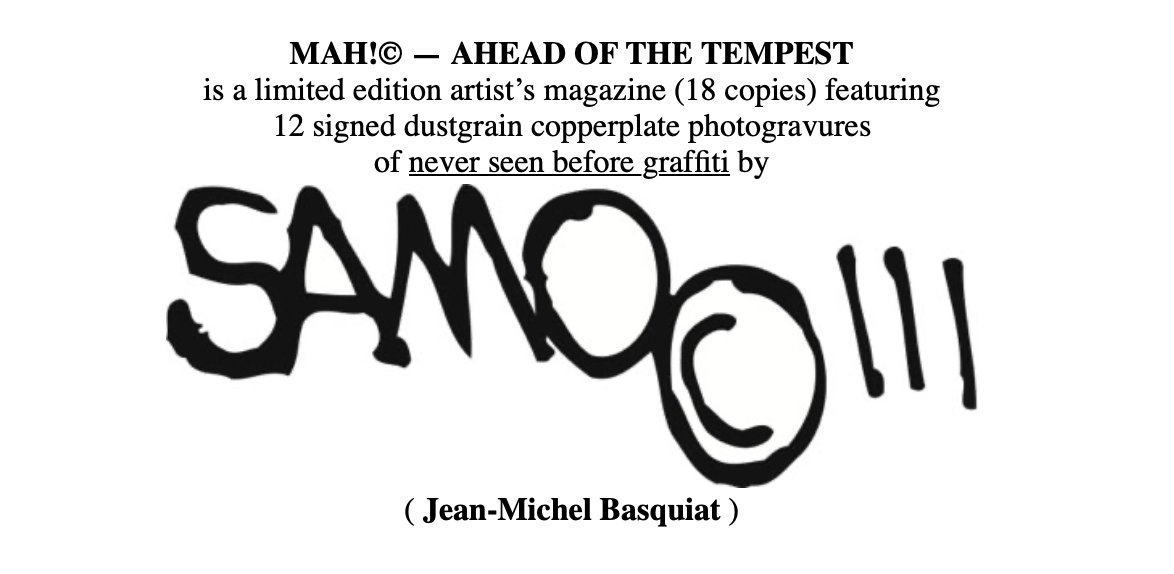
SAMO © [Jean Michel Basquiat (1960-1988), Al Diaz (*1959)], various slogan graffiti, New York, photos: Franco Marinai. In: Mah!, Serrazzano, 2023.
Shortly after his arrival in New York in 1979, the Italian-born experimental filmmaker and graphic artist Franco Marinai photographed, among other things, SAMO©- Graffiti that appeared in his 2024 Mah! Magazine in print for the first time. The graffiti signed TM [trademark] forms a new-found subgroup of the SAMO© slogans, in which Diaz and Basquiat saw themselves as an art guerrilla group.
Link:
MAH!© — AHEAD OF THE TEMPEST
- @albert_diaz1
- @twocentspress
- #aldiaz
SparVar
Standard German spray can from the end of the 1980s, price at the time: approx. 8-9 D-Marks. The color circles on the logo come from the US brand Krylon. SparVar was a Krylon licensed product by the German company SprayColor. The New York writers sprayed with the legendary brands Krylon and Rustoleum.
- @capmatchescolor
- #krylonspraypaint
- #rustoleum
Tom Krojer/Jens Jorgen Thersen (eds.): The Antinational Situationist No. 1 / Den Antinational Situationist No.1. Våxtorp, Sweden / Copenhagen, Denmark: Bauhaus Situationiste, undated [1974]. OS [30 p.]; ill.; 21x29.5cm.
This bilingual magazine from the US/Swedish branch of the Situationists was discontinued after this issue. It is one of the first times that style writing was featured on the cover of a magazine, the caption was simply: “New York, Trains and Houses”.
Mehdi El Hajoui Collection.
- #situationisme
- #situationistinternational
Belton RAL [2 different cans]
This can, designed for hobby use, was produced by the company Peter Kwasny GmbH in the town next to the company Vogelsang (Ultra Color). Better quality than SparVar, it was soon offered cheaply in hip hop shops alongside SparVar. Other brands were mostly stolen and used less.
Private collection.
- @capmatchescolor
- #peterkwasny
- #spraypaintcollector
Anonymous [Guy Debord (1931 – 1994)?], NE TRAVAILLEZ JAMAIS [NEVER WORK], chalk graffiti, Rue de Seine, Paris, ca. 1952 – 53.
In a private letter from 1963, the Situationist leader Debord first claimed that he had created this famous graffiti, but he only made this public shortly before his death in 1993.
Colored black and white photo postcard, Edition Lyna, ca. 1965. Photo and inscription [Les Conseils superflus/superfluous advice]: Louis Bouffier. Mehdi El Hajoui Collection.
- #GuyDebord
- #netravaillezjamais
- #situationisme
Multona
These car paint cans from Peter Kwasny GmbH delivered high-gloss metallic colors. One could choose the color of common car models from a catalog. It had very opaque colors that were otherwise unavailable. Because of the high price of around 15 D-Marks, these were not very common among graffiti writers.
Anonymous [Guy Debord (1931 – 1994)?], NE TRAVAILLEZ JAMAIS [NEVER WORK], chalk graffiti, Rue de Seine, Paris, ca. 1952 – 53.
To this day, people go on a pilgrimage to this wall on Rue de Seine where there was this chalk graffiti in 1953. It was often quoted in the two decades after it was created and distributed as a postcard in several editions.
Black and white photo postcard, Alaph Verlag, ca. 1953. Photo and inscription [Les Conseils superflus/superfluous advice]: Louis Bouffier. Mehdi El Hajoui Collection.
- #GuyDebord
- #netravaillezjamais
- #situationisme
SPAZE/Chaker Abdallah, member of the Graffiti Writer Crew [group] DLK [DibbeLabbes Klan], Blackbook [sketchbook], Saarbrücken, 1994. 48.5 x 34.5 cm.
Like every black book, this sketchbook also contains photos of illegal works and often gifted drawings from other writers. This example is from a member of the DLK crew, named after a Saarland specialty.
Dirk Sold Collection.
- #Saarlandgraffiti
Reso, member of the Graffiti Writer Crew [group] DLK [DibbeLabbes Klan], Blackbook [sketchbook], Saarbrücken, ca. 1994.
The name of the founder of the first Saarbrücken crew sounds like Reseau, French for network. From 1988 onwards, he tirelessly expanded this network internationally beyond Saarbrücken and soon also legally.
- @resostudio
- #saarlandgraffiti
Eiffe article, In: Die ZEIT, May 31, 1968.
“I have authorized myself to describe posters because no one else reads them properly.” (Eiffe) After he drove his graffiti-painted Fiat into the foyer of Hamburg Central Station, Eiffe was incapacitated. He then spent a lot of time in psychiatric clinics against his will. Eiffe's body was found in a moor months after an escape attempt in 1983.
- #eiffeforpresident
- #peterernsteiffe
Disbocolor
This very opaque paint from Caparol comes from a wall paint manufacturer with a small range of spray cans at the time. It was more likely to be available in painting supply stores. Rarely used by graffiti writers due to the high price and almost always stolen.
Private collection.
- @capmatchescolor
- #spraypaintcollector
Uwe Wandrey: Battle rhymes. Hamburg 1968.
Like Eiffe, coming from the impulse of the Parisian corn, these graffiti or demonstration slogans with an extra sharp-edged cover are “suitable for self-defense” (inscription). Slogan graffiti are like visual chants at demonstrations and literature understood as a weapon.
- #fighting rhymes
- #rudidutschke
- #studentmovement
Marabu Buntlack
Since this can could also be used on Styrofoam, it could be found in art supply stores. Prohibitively expensive at around 20 D-Mark per can, ultra opaque and with special, exclusive colors, the Marabu was actually only used for graffiti when it was stolen.
Private collection.
- @capmatchescolor
- #marabubuntlack
- #spraypaintcollector
Hobby paint can
This small can is representative of the many hundreds of cans in different sizes for hobby use that have existed over time without playing a major role in graffiti.
Private collection.
- @capmatchescolor
- @spraypaintcollector
- #spraypaintcollector
(Demon)JAK (Jungle Art Killer)/Yvain von Stebut (*1970), JAK, Graffiti Piece, Villers-sur-Mer, July/August 1991.
As Zéb, Jak was also active with punk stencils. JAK was a hip hop graffiti pseudonym of Stebut from Nancy, who was one of the most important Nancy hip hop pioneers and also worked as a musician and DJ.
Photo: Yvain von Stebut.
- @vontaztika
- #graffitinancy
Uwe Wandrey: Eiffe for President. Hamburg 1968.
This booklet is probably the first monograph dedicated to an illegal street artist. It brings together bon mots like “All traffic lights on yellow.” Interactive graffiti also began with Eiffe; he often left his telephone number and an automatic message.
Lender: Antiquariat im Lenninger Tal
- #eiffeforpresident
- #peterernsteiffe
MashUp, MASH next to a CAFAR graffiti, bridge pillar, A31 to Pont-à-Mousson, 1995.
In Dieulouard (between Nancy and Metz) hip hop reached a teenager via TV shows and music videos in 1982, who later became MashUp. With Kafar he founded the UPK Crew in 1990.
Photo: ©MashUP.
Atelier Populaire de Beaux Arts [Collective], Vermine Fasciste. Action Civique, screenprint poster, Paris, May 1968 [reprint, London 2018, Steve Lazarides].
Banksy's sometime photographer/manager reprinted this May 68 50th anniversary poster to highlight the rat's importance to street art history.
Lender: Ulrich Blanché
- #may68
- #paris1968
- #verminefasciste
King Pin [Christian Wolf] (*1966), King Pin, Graffiti Piece, Brühl, 1983.
The soon-to-be King Pin saw New York graffiti in the September 1983 issue of a German trade union magazine. In Cologne in 1984, he met the pioneering graffiti writer Lee Quiñones and then traveled to New York, where he met local graffiti writers. He became one of the first writers in Germany and also appeared in the influential US illustrated book Spray Can Art in 1987.Photo: King Pin.
- @kunstkabinettmoll
- @LeeQuiñones
- #kingpingraffiti
Miss.Tic/Radhia Novat (1956-2022), DES MURMURES IMPATIENS PRENNENT LA PAROLE SUR LA VOIR PUBLIQUE [Impatient murmurs speak out on the street], stencil graffiti, Rue des Cascades/ Rue F. Raynaud, Paris 1986.
The pochoirist and word player Miss.Tic became the first prominent street artist in Europe in 1985. In the tradition of the poet Prévert, she overcodes her slogans with homophones and ambiguities.
Photo: Jean-Marie Lerat: Je ne fais que passer: Miss.Tic. Paris 1998, p. 7. VG Bild-Kunst Bonn, 2024.
- @missticofficiel
- #misstic
- #pochoir
Delit [Lydia, (*1966)/ Dede (*1967)] stencil graffiti, Rue Blondel, Metz, ca. 1985–1987.
Due to the great media interest in the Parisian pochoirists [stencil graffiti artists], they quickly became popular in smaller cities in France. This is an early example of a work in the greater region.
Photo: Christoph Maisenbacher.
- @christoph_maisenbacher
- #pochoir
- #stencilgraffiti
Richard Hambleton (1952 – 2017), Image Mass murder, Canada/USA 1976 – 79.
This early street art series of fictional murder victim outlines, including (blood) red stains, comprised 620 illegal works in 15 North American cities. Passers-by were left in the dark as to whether it was a crime or anonymous art. Only in the press, gallery exhibitions and a mail art booklet did Hambleton declare his authorship of this series, which was influenced by comics and detective films.
- #ImageMassmurder
- #mailart
- #richardhambleton
Taki 183/Demetrius (approx. *1953), Barbara 62, Eva 62, Phase 2/ M. Marrow (1955-2019), Joe 136, Joe 182, Lee 163 rd , etc., tags, subway staircase exit , New York, July 27, 1972.
Two generations of early tagging history are represented here. Small marker graffiti from Taki 183 are overlaid by larger spray tags - some from the same writers who were among the most prominent of their time. Phase 2 and Lee 163 rd are already interlocking their letters, Rat is relying on new pictorial gimmicks.
Photo: Associated Press.
- #lee163rd
- #taki183
Delit [Lydia, *1966, Dede, *1967) Stencil Graffiti, Rue Nicolas-Remiat, Metz, ca. 1985–1989.
This pochoir duo is one of the earliest street artists in the greater region between Saarland, Rhineland, Lorraine and Luxembourg. After political slogans and hard rock band fan graffiti in the early 1980s, stencil graffiti can be found in the local press in the greater region from 1987 onwards.
Photo: Christoph Maisenbacher.
- @christoph_maisenbacher
- #pochoir
- #stencilgraffiti
Cornbread collage
Banksy spray-painted a live elephant at an exhibit in 2006 also as a tribute to Cornbread, who did so illegally at the Philadelphia Zoo in 1970. This presumably first graffiti writer wrote “Cornbread” on walls in prison to protest against the lack of cornbread. In 1967 he continued painting this word as a tag on the street. Before that, only gangs did that. Illegal urban guerrilla ego advertising was as new as its medium: felt-tip pens and spray cans had barely been ready for the market before.
- @cornbreadthelegend
- #cornbreadgraffiti
- #cornbreadthelegend
Cornbread/Darryl McCray (*1953), etc. Spray graffiti tags, closed subway station, Philadelphia, circa 1970s. Photo: Cornbread 2023.
Due to urban planning restructuring, some of these ghost stations have been sealed for decades. They can only be accessed illegally by those in the know, such as graffiti writers. There is also a Cornbread tag from around 1970 at this station.
- @cornbreadthelegend
- #cornbreadgraffiti
- #phillygraff
Oliver (*1964), Stencil Graffiti, Strassbourg, 1987.
Olivier's highly site-specific, unsigned floppy hat figures 1985-1995 were very well known in photos, postcards and book publications. Initially anonymous, around 1990 Olivier's works were the most published illegal street art in the greater region.
Photo: Christoph Maisenbacher.
- @christoph_maisenbacher
- #pochoir
- #stencilgraffiti
OZ /Walter Fischer (1950–2014), graffiti, power box, 58.3 x 156.0 x 27.7 cm, Hamburg, approx. 1991.
Unprecedented in street art history, OZ created tens of thousands of illegal works between 1977 and 2014, for which he had to go to prison for a total of 8 years. Apparently hit by an S-Bahn while spraying, he died in 2014. Even 10 years after his death, his tags are omnipresent in Hamburg.
Collection of the Museum of Hamburg History.
- @oz.hamburg@city_of_oz.hamburg
- #ozhamburg
Zéb(ulon)/Yvain von Stebut (*1970), V2, Red Matrak, Stencil Graffiti, Rue du Maure corner Grande Rue, Nancy, 1987/88.
This collaboration between Zéb and V2 was created in a left-wing punk graffiti context. Both were members of the punk band Yvain von Stebut et les Hémorroïdes.
Photo: Yvain von Stebut.
- @vontaztika
- #stencilgraffiti
- #streetartnancy
Stollwerck Wall [occupied chocolate factory], Cologne 1983-84.
Here the Neue Wilde painter Walter Dahn (*1954) anonymously sprayed Rock da House and, with the New York painter star George Condo (*1957) a devil's hand. In the case of Death Squad, the spray draftsman Marcus Krips (*1965) surprised Dahn at night and added a punk head. With Dahn's cans, the train graffiti writer Daze painted here in 1984, probably the first illegal style writing works by a New York pioneer in West Germany. We can also find a spray drawing attributed to Dahn’s colleague Jiří Dokupil (*1954) on this wall.
Photos: Thunar Jensch, © Rheinisches Bildarchiv Köln.
- @dazeworldnyc
- @kripskunst
- #walterdahn
Graffiti - the message passe. In: Regional newspaper Le Républicain Lorrain, January 27, 1987.
The article shows early, mostly anonymous stencil graffiti, which were seen a lot in the media from the mid-1980s onwards due to the popularity of the Paris Pochoirists.
- #pochoir
- #stencilgraffiti
- #streetartlorraine
Anonymous [Guy Debord (1931-1994)?], NE TRAVAILLEZ JAMAIS [NEVER WORK], chalk graffiti, Rue de Seine, Paris, ca. 1952-53. Colored photo postcard, Edition Lyna, ca. 1965.
A quote from the poet Rimbaud became the creed of graffiti of the artist group Situationists and then of the student movement - symbolizing a rejection of work perceived as detached from life.
Photo/Inscription [Les Conseils superflus/superfluous advice]: Louis Bouffier.
- #GuyDebord
- #netravaillezjamais
- #situationisme
Peter Ernst Eiffe (1941–ca. 1982), Eiffe the bear is coming soon., felt-tip graffiti on traffic sign, Börsenbrücke corner Gr. Johannisstr. Hamburg, May 1968.
Before Eiffe, no illegal felt-tip pen and spray can users are known by name in Germany. With the “felt-tip pens” and spray cans introduced in 1967, Eiffe was able to write slogans with unprecedented speed.
Photo: The Thede.
- #eiffeforpresident
- #peterernsteiffe
[Edmond] Marie Rouffet (ca.1955-2017), Rock 'N' Nana, stencil, Reaumur-Sebastopol metro station, Paris, 1984, postcard. Approx. 11 x 15.3 cm.
The artist signed with his real name, but omitted his first name Edmond, which had a male connotation. In 1986 he was the best-known pochoirist in Paris, alongside Blek and Miss.tic. His serially arranged motifs combined text and image stencils for the first time.
Lender: Ulrich Blanché.
- #marierouffet
- #pochoir
Eiffe goes around in Hamburg, In: Süddeutsche Zeitung, No. 126, May 25-26, 1968, p. 10.
The great media response throughout Germany testifies to the novelty of Eiffe's slogan graffiti, which fluctuated in a humorously surreal way between politics and poetry.
- #eiffeforpresident
- #peterernsteiffe
Blek le Rat/Xavier Prou (*1951), self-portrait, stencil graffiti, Île Saint-Louis, Paris, 1984, "Paris Graffiti" postcard, 11 x 15.3 cm, photo: Rosine Klatzman.
Postcards spread street art quickly and inexpensively. This photo was taken for a press article in December 1984. It is predated to 1982/83 on Blek's website.
Lender: Ulrich Blanché.
- @blekleratoriginal
- #BlekleRat
- #pochoir
In Hamburg people ask themselves: Who actually is Eiffe? In: Hamburger Abendblatt, No. 119, Volume 21, May 22, 1968, p. 3.
Many of his graffiti “word surrealisms” (Eiffe) referred to the claim of the “court jester of the extra-parliamentary opposition” (Frankfurter Rundschau) to run for mayor: “Don’t be a pfeife [honk], vote for Eiffe.”
- #eiffeforpresident
- #peterernsteiffe
Anonymous, We are on strike laze around, graffiti on flyer, Saarbrücken University, May 1968.
The old cliché of the “lazy” student is used here by non-student graffiti against the 1968 uprisings. It humorously shows the clash of generations.
Photo: Saarbrücken University Archives.
- #1968
- #rudidutshke
- #studentmovement
Anonymous, If this lady was a car... she'd run you down. Fiat advertising board with anonymous spray-painted graffiti, Farringdon, London, 1979.
The photographer Jill Posener was one of the first to photograph and publish anonymous activist slogan graffiti around 1980, which was also dedicated to the rights of women, lesbians and gays, animal protection and anti-war efforts.
Photo: Jill Posener.
- @queerstreetart
- #JillPosener
- jill_posener_photography
Blek le Rat/Xavier Prou (*1951), Tom Waits stencil, cardboard, 123 x 93 x 1 cm, 1983.
Starting in 1985, graffiti from this stencil appeared on three book covers. Blek’s template was the cover photo of a Waits album from autumn 1983. In Paris, Blek's huge pochoirs [stencils] influenced early street artists and graffiti writers.
Johannes Stahl Collection, Siegburg.
- @blekleratoriginal
- #BlekleRat
- #pochoir
Crass, various stencil graffiti, Bond Street Station, London, 1979.
With the exception of this wall, from 1977 onwards, the anarcho-punks Crass - influenced by political post-68 stencils in Paris - only sprayed activist-poetic stencils on sexist or "exploitative" advertising posters in the London subway system. The photo became the cover motif for her record “Stations of the Crass”, the title of which alludes, among other things, to the graffiti campaign in subway stations stenciled by Crass.
Photo: Crass.
- @crasswords
- #crassband
- #PennyRimbaud
Banksy (ca. *1974), ant, stencil graffiti, Bristol, ca. 1992–1997.
Even though Banksy, probably under another pseudonym, began tagging graffiti earlier, this work marks his first step towards street art. Instead of his graffiti tag, the young Banksy began stenciling a monstrous ant in the spotlight.
Photo: Richard Jones, Tangent Books.
- @banksy
- @banksyarchive
- #stencilgraffiti
R. Hambleton, Nightlife/Shadowman, brush graffiti, G. Zlotykamien, Ephemeres, spray graffiti, J. Mesnager, Homme Blanc, brush graffiti, former Place Saint Josse, Les Halles, Paris, 1984.
French street art pioneers pay tribute to Hambleton here. Shortly after their New York launch in 1981, his Shadowmen received international press coverage. In the twilight, they frightened passers-by and invited them to add their own eyes, feelers, horns, etc.
Photo: Jean-Noël Lafargue.
- @jeromemesnager
- @zlotykamien
- #richardhambleton
Richard Hambleton (1952–2017), Nightlife/Shadowman, Katrin Kaluza (*1959), red female figure, Marcus Krips (*1965), spray drawing, Walter Dahn (*1954), horns, Ubierring, Cologne, 1984-86.
Hambleton was the first street artist to travel internationally with great media coverage and gave new impetus to illegal street art in places like Cologne and Paris.
Photo: Johannes Stahl.
- #marcuskrips
- #richardhambleton
- #walterdahn
Dan Witz (*1957), Broadway Poem, metal letters embedded in asphalt, Broadway, New York, 1980.
Since 1978, New York painter and street art pioneer Dan Witz has been creating self-authorized, illegal, anonymous interventions on the street, here a Dada-inspired poem: “I hammered about 50 words into the asphalt of Broadway.” Back in 1983 he published The Birds of Manhattan, an early street art photo book of his series with the same name.
Photos: Dan Witz.
- @danwitzstreetart
- #danwitz
- #danwitzstreetart
PATTI SMITH 29/30 JULY NEW ELGIN, Guerrilla Punk Concert Advertising, Stencil Graffiti, Manhattan, New York, 1977.
This perhaps earliest documented punk stencil was an illegal guerrilla advertising. Punk's often visually crude DIY culture influenced much later street art.
Photo: © GODLIS.
- @godlis
- #pattismithgroup
- #stencilgraffiti
PATTI SMITH© 29/30 JULY NEW ELGIN, Guerrilla Punk Concert Advertising, Stencil Graffiti, Manhattan, New York, 1977.
The philosopher, experimental musician and artist Henry Flynt photographed the majority of the SAMO© graffiti known today. No Basquiat museum retrospective or street art history is complete without them.
Photo: #26, Henry Flynt.
- @albert_diaz1
- #henryflynt
- #samograffiti
Alex Vallauri (1949–1987), stencil graffiti, New York, 1982–83.
Years before Blek, Vallauri initiated a stencil graffiti movement in São Paulo. Before his early death from AIDS, he influenced early stencil street art in the USA, Poland and France. He is considered Brazil's graffiti godfather, had museum retrospectives and is cited as a forerunner by the Brazilian street art stars Os Gêmeos (*1974). The anniversary of his death is the day of graffiti in Brazil.
Photo: Alex Vallauri/ CEMIS SP /Claudia Vallauri.
- @OsGêmeos #stencilgraffiti
- #AlexVallauri
Castrate Rapists, anonymous stencil graffiti, Manhattan, New York, ca. 1976.
The British Gee Voucher (*1945) photographed the rough, military-looking stencil font of this feminist graffiti before she designed the covers for Crass, making a similar font a Crass trademark.
Photo: Gee Voucher.
- @crasswords
- #geevaucher
- #InternationalAnthem
Keith Haring (1958-1990), chalk drawing on blank billboard, subway system, New York, ca. 1981.
Now world-famous, Haring had his breakthrough with thousands of extremely short-lived illegal chalk drawings in the subway system, which he created in plain sight during the day in order to be able to communicate with passers-by. With playful comic pop line drawings, Haring created his own vocabulary that was highly recognizable, with which he often commented on billboards next to them or political events.
Elisabeth & Günter Wittmann Collection.
- @keith_haring_photos
- @keithharingfoundation
- #KeithHaring
Guerrilla Girls stick their poster “WHAT DO THESE ARTISTS HAVE IN COMMON?” masked on a street in Manhattan, New York, ca. 1985.
25 years before Banksy, the Guerrilla Girls created street art in gorilla masks to protect their anonymity. They called themselves the conscience of the (New York) art world and used “name & shame” to accuse powerful representatives of the art world of structural sexism.
Photo: Lori Grinker/ Guerrilla Girls, courtesy guerrillagirls.com.
- @guerrillagirls
- #feministstreetart
- #guerrillagirls
Guerrilla Girls, WHAT DO THESE ARTISTS HAVE IN COMMON? [What do these artists have in common?], first wild poster, New York City, 1985.
The often funny or sober numbers/data/facts posters of these feminist street art pioneers denounced unequal treatment and sexism in the art world.
Photo: © Guerrilla Girls, courtesy guerrillagirls.com.
- @guerrillagirls
- #feministstreetart
- #guerrillagirls
Guerrilla Girls, Do Women Have to Be Naked to Get Into The Met. Museum? [Do women have to be naked to get into the Met Museum?], wild poster, on the street, New York City, 1989.
This best-known work by the group highlights gender inequalities in museums that continue to exist until today.
Photo: © Guerrilla Girls, courtesy guerrillagirls.com.
- @guerrillagirls
- #feministstreetart
- #guerrillagirls
Christy Rupp (*1949), Rats in line, wild posters, each 13.97 x 44.45 cm, Paste ups, New York, 1979.
Rupp's rats received a lot of media attention after a garbage strike in New York. Journalists photographed Rupp's rat poster on a street where rats had allegedly attacked a woman. Years before Blek le Rat or Banksy, the illegal paste-up street art pioneer Rupp created her most famous work with rats.
Photo: Christy Rupp.
- @christy_rupp
- # christyrupp
- #pasteups
SAMO© [Jean Michel Basquiat (1960–1988), Al Diaz (*1959)], slogan graffiti, marker & spray can, SoHo/Lower East Side, New York, 1979.
Basquiat is one of the most expensive artists in the world today. He became known for his SAMO© slogan graffiti - Basquiat's ticket to the art world, created with ex-graffiti writer Al Diaz. Shown here for the first time and recently discovered are ten SAMO© graffiti - each a poetic-critical commentary on the zeitgeist of the era.
Photos: Franco Marinai.
- @albert_diaz1
- #basquiat
- #samograffiti
Jenny Holzer (*1950), from Truisms [truisms], 1977 – 79. Wild posters, 91.4 x 61 cm, installation New York, 1977.
The paste-up pioneer is the first female street artist. She has been exhibiting in well-known museums around the world for decades. In 2015, Holzer was invited to Banksys group exhibition Dismaland - 35 years after she exhibited in the Times Square Show (New York), the first show uniting graffiti writers and street artists.
Photo: Jenny Holzer. VG Bild-Kunst, Bonn 2024.
- @jennyholzerstudio
- #JennyHolzer
- #pasteups
John Fekner (*1950), WHEELS OVER INDIAN TRAILS, spray stencil graffiti, H: 90 cm, Pulaski Bridge, Queens Midtown Tunnel, New York, 1979 [removed by the artist in 1990].
The environmental conceptual artist/activist was the first to paint monumental illegal street art in the United States. The classically trained Fekner collaborated with graffiti writers like Crash early on and recorded music. The song of the same name of the graffiti shown here, can be found on his album Idioblast.
Photo: ©John Fekner.
- @JohnFekner
- #JohnFekner
- #wheelsoverindiantrails
Zygmunt Piotrowski (*1947) [with Jacek Malicki (*1946)], portrait, chalk drawing, action on the street, corner of Mazowiecka and Kredytowa streets, Warsaw, 1978.
Independently and at the same time as Fekner in New York, Piotrowski drew the first monumental street art in socialist Poland. The performance artist and temporary art market refuser Piotrowski was a central figure in Poland's alternative art scene.
Photo: Zygmunt Rytka. ©Zygmunt Piotrowski.
- #noahwarsaw
- #streetartpoland
- #zygmuntrytka
(David) Soner (*1974), CECI N'EST PAS UN CRIME [that is not a crime], Piece, Laquenexy, 1992, and preliminary drawing from Blackbook.
The skateboarder Soner in Metz was inspired to do graffiti himself by a Mode 2 graffiti piece on the cover of skater magazine Noway (January 1990).
Photo: ©Nesh.
- @davidsoner1
- #davidsoner1
- #metzgraffiti
Futura 2000/Leonard McGurr (*1955) with punk band The Clash-Shirt at the New York City Rap Tour 1982 concert in the Salle Europa in Montigny les Metz, November 29, 1982.
The virtuoso graffiti pioneer had just recorded a rap single about graffiti with The Clash.
Unpublished photo: Michel Pira, Archive Le Republicain Lorrain 16336797.
- @Futuradosmil
- @the_clash
- #newyorkcityraptour
Francis Kochert: Feeling of New York. le rap débarque. In L'Affiche Le Républicain Lorrain, November 27, 1982.
The NY City Rap Tour, which brought hip-hop to Europe, sent an important impulse to the greater region. It combined all elements of hip-hop and presented dozens of rappers, graffiti writers, break dancers and DJs. The tour started on November 21, 1982 in Paris and then continued to Lyon, Belfort, Mulhouse, Strasbourg, London and Los Angeles.
Archive Le Republicain Lorrain.
- @Futuradosmil
- #futura2000
- #newyorkcityraptour
Adrenaline, Graffiti Zine, 5 issues, Saarbrücken 1995-1999. Double-H Archive, Reso Collection.
Saarbrücken also had its own graffiti zine from the mid-1990s, initially photocopied, but from issue 2 onwards it became more and more professional, as the latest computer software was now used.
- @resostudio
- #graffitizines
- #saarlandgraffiti
First article in Europe on the topic of Pichação with photos by Os Gêmeos. Xplicit GrafX magazine, December 1998.
Although practiced since the 1980s, this Brazilian form of graffiti was unknown in Europe until the late 1990s. Classic graffiti writing in Brazil is mostly legal and decorative. Pichação, on the other hand, is more of an illegal extreme sport with paint.
Photos: Os Gêmeos, Xplicit GrafX magazine.
- @anarcoletters
- @OsGêmeos
- #Pichação
Rabiscos que infernizam a vida da cidade [Doodles that make life in the city hell], in: Daily newspaper O Estado de S. Paulo, November 24, 1989.
- @anarcoletters
- #Pichação
Threat from the mayor to the illegal Pichação writer Juneca [Oswaldo Junior, *1973] and Bilão [Fernando Monteiro Júnior, *1974], published on the front page of the supplement to the official gazette of the municipality of São Paulo, October 4, 1988.
- @anarcoletters
- @junecajuniorartes
- #Pichação
Ted Joans/ Theodore Jones (1928 – 2003), More Lightning Love Poems, Munich 1982.
Using chalk and charcoal, Joans sent outthree of his jazz fan friends throughout Manhattan to write the slogan `Bird Lives!` in subway stations and on walls.
- #birdlives
- #CharlieParker
- #TedJoans
Ted Joans/Theodore Jones (1928-2003), Bird Lives! Review 2. In: Coda. Canada's Jazz Magazine. December 1973, pp. 7-9.
In 1973, 18 years after its first publication, in this article the poet, sometime jazz musician, former roommate of the late Charlie Parker and surrealist painter Ted Joans claimed that the famous New York "Bird Lives!" graffiti were specifically created by him.
- #birdlives
- #CharlieParker
- #TedJoans
Jacques Prévert (1900 – 1977), La Pluie et le Beau Temps, Paris 1962.
Jacques Prévert not only honored graffiti in the form of the Brassaï photos, but also tried to transfer the structure of graffiti into a literary form. Prévert also wrote a poem about his friend Brassaï that mentions graffiti. Both were close to the Surrealists for a while.
Book cover: Prévert and photo by Brassaï.
- @paris_de_nuit
- # Brassai͏
- #jacquesprevert
Jacques Prévert (1900 – 1977), Histoires, Paris 1965.
Five Prévert paperback and record covers with Brassaï's graffiti photos appeared between 1945 and 1965, contributing to their popularity among a wider audience.
Book cover: Prévert and photo by Brassaï.
- @paris_de_nuit
- # Brassai͏
- #jacquesprevert
Jacques Prévert (1900 – 1977), Paroles. Paris [1945] 1957.
Prévert, a poet and screenwriter very popular in post-war France, had known the photographer Brassaï since 1930. In the summer of 1945, Prévert suggested using a Brassaï graffiti on the cover of a collection of his own poems. Paroles became on of the most printed poem books in France.
Book cover: Prévert and photo by Brassaï.
- #Brassai͏
- #jacquesprevert
- #prevertparoles
Jacques Prévert (1900 – 1977), Spectacle, Paris 1959.
The simplicity and clarity of many of Prévert's poems are reminiscent of graffiti slogans on the street. Full of puns and surprising metaphors, they convey a catchy message.
Book cover: Prévert and photo by Brassaï.
- @paris_de_nuit
- #Brassai͏
- #jacquesprevert